

LABOR TENSIONS IN MONTANA IN THE EARLY 20TH CENTURY - THE CONVICT CHAIN GANGS OF CUSTER COUNTY
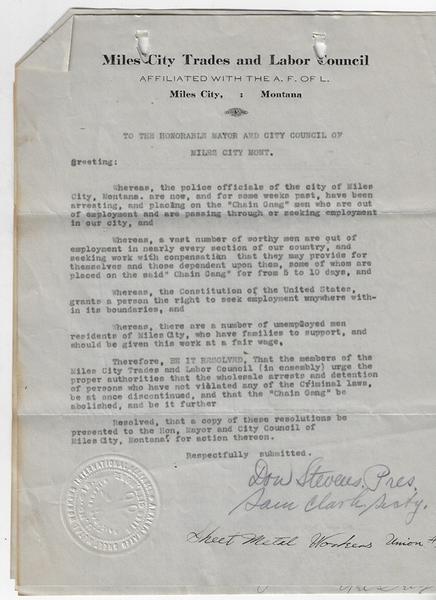
MILES CITY TRADES AND LABOR COUNCIL. AFFILIATED WITH THE A.F. OF L ... Miles City, Montana. Five copies of a single typed letter TO THE HONORABLE MAYOR AND CITY COUNCIL OF MILES CITY MONT. Each letter, each of which are signed by representatives of a particular union are each blind-stamped by that individual union with one of the letters stating “Filed May 25, 1914” The letter stamped unions represented are Sheet Metal Workers Union #419, the International Brotherhood of Blacksmiths & Helpers, Culinary Workers Union #524, The Miles City Trade and Labor Council and Federal labor Union No. 12968. The Federal Labor Union’s letter ends with the manuscript note “Respectfully adopted and approved by the Federal Labor Union No. 12968. There is not a union’s blind-stamp on the Brotherhood of Blacksmiths letter.
John Axline, in his article Building Permanent and Substantial Roads…. writes “Montana’s highways at the dawn of the automobile age were truly abysmal….Federal and private efforts to improve roads coincided with the creation of the Office of Public Roads Inquiry in 1893 and the rise of Montana’s Good Roads movement in the early twentieth century…. The question was who would undertake the actual construction. Governor Edwin Norris, a supporter of the Good Roads movement, had strong opinions on the matter: ‘The chief aid of the state to the betterment of our highways can come only by working the convicts on the roads.”
“The road projects were the most visible of the convict labor programs and almost immediately drew fire from labor unions….Although Norris assured the unions that convicts would only be used on state roads in counties that did not have the money to construct the roads themselves, the union representatives announced their opposition to the use of prisoner labor.”
These letters lay-forth the constant conflict between migrant laborers, convict chain-gangs and local labor unions. The Miles City Trades and labor Council protest what appears to be a concerted effort by law enforcement to “recruit” for chain gangs.
The total letters state:
Greetings:
“Whereas, the police officials of the city of Miles City, Montana, are now, and for some weeks past, have been arresting, and placing on the “Chain Gang” men who are out of employment and are passing through or seeking employment in our city, and
Whereas, a vast number of worthy men are out of employment in nearly every section of our country, and seeking work with compensation that they may provide for themselves and those dependent upon them, some of whom are placed on the said “Chain Gang” for from 5 to 10 days, and
Whereas, the Constitution of the United States, grants a person the right to seek employment anywhere within its boundaries, and
Whereas, there are a number of unemployed men residents of Miles City, who have families to support, and should be given this work at a fair wage,
Therefore, BE IT RESOLVED, That the members of the Miles City Trades and Labor Council (in ensembly) urge the proper authorities that the wholesale arrests and detention of persons who have not violated any of the Criminal laws, be at once discontinued, and that the “Chain Gang” be abolished, and be it further
Resolved, that a copy of these resolutions be presented to the Hon. Mayor and City Council of Miles City, Montana, for action thereon.
Respectfully submitted:
Source: John Axline, “Building Permanent and Substantial Roads: Prison Labor on Montana’s Highways, 1910-1925” in Montana The Magazine of Western History, Vol. 62, No. 2 (Summer 2012), pp. 59-66.
Each letter is 8 ½ x 11 inches, and signed by a representative officers of the particular union. Two holes at top of each letter where it had been previously fastened. Overall in vg cond.