SAN FRANCISCO – OAKLAND BAY BRIDGE ARCHIVE
SAN FRANCISCO – OAKLAND BAY BRIDGE ARCHIVE
Construction of the San Francisco-Oakland By Bridge Reports…
Report #1 – THE SAN FRANCISCO -OAKLAND BAY BRIDGE TRIANGULATION NET by Donald R. Warren. Chief of Division of Triangulation and Surveys – San Francisco-Oakland Bay Bridge. September – 1933. Copy. “The location of the structures which will unite to form the San Francisco-Oakland Bay Bridge, joining the metropolitan areas on San Francisco Bay, offers many problems that are not common to ordinary engineering practice.”
“The bridge, more than eight miles in total length, extends more than four miles over the surface of the Bay. The continuity of the bridge is severed near its mid-point by the intervention of Yerba Buena Island, rising 340 feet above the surface of the Bay. To measure the distance to the Island from either shore by the application of ordinary steel tape is impractical. However, by the application of the principles of trigonometry and geometry it is possible to determine these distances quite accurately.”
The paper consist of 20 pages and quite fascinating and detailed as all of these reports are.
Report #2. – SUSPENSION SPANS – SAN FRANCISCO -OAKLAND BAY BRIDGE. Prepared for The Sacramento Section of The American Society of Civil Engineers by Donald R. Warren. Senior Bridge Field Engineer. April 23, 1935. Copy. 10 pgs.
“That portion of the San Francisco-Oakland Bay Bridge which will span the west channel of the San Francisco Bay and join Rincon Hill in San Francisco to Yerba Island will consist of two suspension bridges. These bridges, joined in mid-channel by a common anchorage, have central spans of 2310 feet, with two side spans of 1160 feet. The backstay of the westerly bridge extending to the anchorage, located at the foot of Rincon Hill, will be 600 feet longer than that of the easterly span with its anchorage near the bridge heading on Yerba Buena Island.”
“In the original design, provisions were made for navigation by providing a clearance of 180 feet at the pier heads and 220 feet at mid-channel.”
“The bridge, when completed, will be quite flexible. Under extreme conditions of temperature and loading, the main span may fluctuate from 10 ½ feet below to 15 feet above normal, with a maximum design change in elevation of 25 ½ feet. The calculated horizontal deflection, resulting from a gale of 90 miles an hour, will be 9 feet. However, these extreme conditions provided for int the design of the bridge undoubtedly will never obtain.”
“The spinning of cables will begin the latter part of May, 1935, and should be completed early in 1936. It is expected that the bridge will be open for traffic the latter part of 1936.”
Report #3. LANDING OF WEST BAY PIERS. 2 pgs.
“The landing of the West Bay caissons from a floating condition in 70 feet to 105 feet of tidal water was one of the critical stages of construction. Before landing, the caissons moved in a rhythmic orbit from the influence of the mixed tide peculiar to the Pacific Coast. This orbit of elliptical shape varied with the magnitude and direction of the tidal currents produced by a mean diurnal range of more than four feet. Although the duration of slack water between tidal phases was but fifteen minutes, it was the practical time to land the caissons.”
“Prior to landing, the movement of each caisson as it tugged at its anchor line was observed continuously for several days. From the results of these data, combined with additional instrument observations from the triangulation stations on shore, it was possible to predict the position of the caisson from minute to minute as it approached the mud.”
Report #4. STATE OF CALIFORNIA – DEPARTMENT OF PUBLIC WORKS. SAN FRANCISCO-OAKLAND BAY BRIDGE. Field Division. July 1, 1934. Mr. Chas. E. Andrew, Bridge Engineer. San Francisco-Oakland Bay Bridge. San Francisco, California. The report it self was written by Donald R. Warren. Senior Field Bridge Engineer. July 1, 1934. Copy, 11 pgs.
“The erection of the separate structures which unite to ultimate form the San Francisco-Oakland Bay Bridge requires a technique in construction surveying which has not been equaled in other bridge projects. To appreciate this, one needs only to consider the careful construction surveys that were required to locate the structures for major bridge projects such as the Golden Gate, Carquinez, Suisun Bay, Brooklyn, Quebec, Sidney Harbor, etc. and then compare them with the surveys for the San Francisco – Oakland Bay Bridge, which is thousands of feet longer. The superstructure of this bridge, with a total length of 27,640- feet, not only spans the 8,270 feet west channel of San Francisco Bay, but it pierces Yerba Buena Island with a tunnel, and then curves over the 9,060 feet East Bay channel to the Oakland shore.”
Report #5. THE VIEWPOINT OF MODERN TRANSIT MANAGEMENT AS TRUSTEE FOR INVESTOR, EMPLOYEE, AND CAR RIDER. An Address at the Annual Convention of the American Transit Association at Cleveland, Ohio, Sept. 25, 1934 by Alfred J. Lundberg. President. East Bay Street Railways, Ltd. Oakland, California. 14 pgs.
Report #6. HOW MASS TRANSPORTATION WILL BE HANDLED OVER THE SAN FRANCISCO-OAKLAND BAY BRIDGE. (Talk by Alfred J. Lundburg, President, Key System, Ltd., before the Pacific Railway Club, Oakland, California, September 12, 1934.) 15 pgs.
“The problem of public transportation over the bridge is both an engineering and an economic one. Curiously enough it is the commuters who make the problem difficult on both counts. These are the people going westbound in the morning from home to business, and eastbound in the evening from business to their homes. Despite the many reductions in hours of labor, practically all commuters wish to travel within a space of an hour or two in morning and in the evening. If the total travel could be evenly distributed throughout the 24 hours of the day it would be an easy matter to handle. But, to properly handle it within the limitations of time in which these people wish to ride, it is found that as a practical matter there is only one way to adequately serve these people and that is by multiple unit trains.”
“I hope, however, that my talk will have given you some idea of the less dramatic, but still important problems involved in furnishing public transportation over the Bridge, which is a feature of this 75 million dollar structure that is absolutely necessary in order that it may serve the public interest in the true sense of those words; namely, the greatest good to the greatest number.”
MEMORANDUMS -
1. February 16, 1934. Memorandum. Subject: San Francisco-Oakland Bridge. San Francisco Approach Problem. 2 pgs. William H. Crawford, Director Industrial Development. Carbon copy.
2. Feb. 26, 1934 – Memorandum Subject – Conference with Key System – SF Bridge. 1 pg, Carbon copy.
3. Feb. 27, 1934 – R-13. Memorandum – Subject: San Francisco-Oakland Bay Bridge. Passenger Busses on Bridge. 2 pgs. Submitted by Ward Hall – Assistant Engineer. Carbon copy.
4. Feb. 27, 1934. R-13. Memorandum. Subject: San Francisco-Oakland Bay Bridge. San Francisco Terminal. 2 pgs. Submitted by Ward Hall – Assistant Engineer. Carbon copy.
5. February 27, 1934. R-13. Memorandum. Subject: San Francisco-Oakland Bay Bridge. San Francisco Terminal. 3 pgs. Submitted by Ward Hall – Assistant Engineer. Carbon Copy.
6. April 20, 1934 - Bus transportation on San Francisco-Oakland Bay Bridge memorandum. 1 pg. Carbon copy.
Summary of Estimates of 7 Plains Considered for Interurban Service On San Francisco-Oakland Bay Bridge Including 15% For Contingencies – 1 pg.
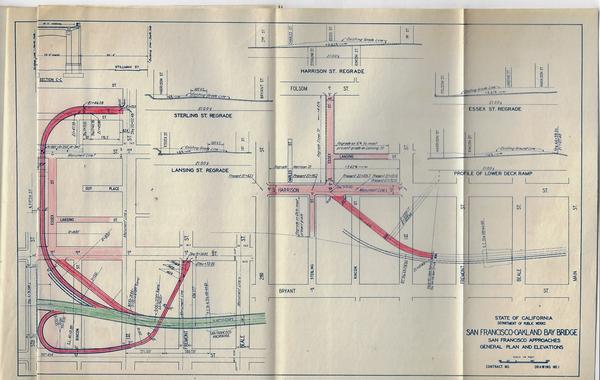
The archive also includes letters and blueprints for various railroad tracks, including the Market Street Railway and its Physical Relationship to the First and Fremont Streets and the main arteries of travel for the auxiliary ramps. Also includes discussions of elevations and terminal layout.
Other areas of inclusion in relation to the San Francisco-Oakland Bay Bridge are:
1. Key System Transit Co.
2. Southern Pacific Railroad
3. Municipal Railway of San Francisco-Oakland
4. Market Street Railway...”Mr. Hammerstrom informed us that the Market Street Railway had a franchise on First Street, which had 25 years yet to run. He stated that they did not intend to relinquish this franchise. Mr. Ost remarked that it was his impression that the City of San Francisco owned the streets and if we desired to make any changes on the streets it would be necessary to approach the city and ascertain their attitude before making our plans too definite.”
Materials relating for a suburban terminal in San Francisco in connection with the San Francisco Bay Bridge.
6. Numerous statistical charts from the State of California, Department of Public Works, Division of Highways.
7. Sacramento Northern Cars to operate over Bay Bridge.
8. Electric Cars required over the bridge – 1934 volume of traffic.
9. San Francisco-Oakland Bay Bridge Key Equipment.
10. San Francisco-Oakland Bay BridgeEquipment. S.P. Co. Equip Cars for 600/1200 volt operation (Exclusive of General Expenses and Interest During Construction.)
11. San Francisco – Oakland Bay Bridge Equipment. S.P. Co. Car Signals and Continuous Control.
12. Railway car construction for operation over the San Francisco-Oakland Bay Bridge. July 21, 1934 “Further on the subject of aluminum and its alloys versus stainless steel for car construction for operation over the San Francisco-Oakland Bay Bridge, where equipment would be subjected to salt air and fog and even to spray during rough weather on the Oakland approaches, the attached Report of the Subcommittee on Aeronautics to the Committee on Naval Affairs of the House of Representatives is very pertinent and will probably be of much interest to you.”
13. Calculated Peak Hour Travel on Trans Bay Service of Southern Pacific (Oakland and Alameda Piers) and Key System Limited for the year 1925...1928...1933.
14. San Francisco – Oakland Bay Bridge Walking Distance in San Francisco To Several Proposed Terminals.
15. A Study on the “Feasibility of substituting motor coaches for the proposed electric interurban railroad which will operate across the San Francisco-Oakland Bay Bridge. “The generous reception accorded to, and the genuine interest shown in, the “Zephyr” in all localities demonstrates its public appeal. Similar construction in trains for the San -Francisco – Oakland Bay Bridge should do much in regaining the revenues which fallen away in trans-bay service in the past few years.”
16. Brief covering the “Burlington Zephyr” A Self-Propelled, Three Car, articulated train of stainless steel construction.
17. May 1, 1934 “Submitted herewith is a report on a study and analysis of the vehicle traffic across the San Francisco-Oakland Bay Bridge and its distribution in and about San Francisco. In brief, this report, based on the “Eastbound and Westbound Vehicle Check of December 17, 18, 1929, covers the traffic movement by the hours, both to and from the various zones into which the city has been divided for this vehicle check, along the several routes which have been chosen for well defined reasons hereinafter delineated.” 5 pages plus 5 charts.
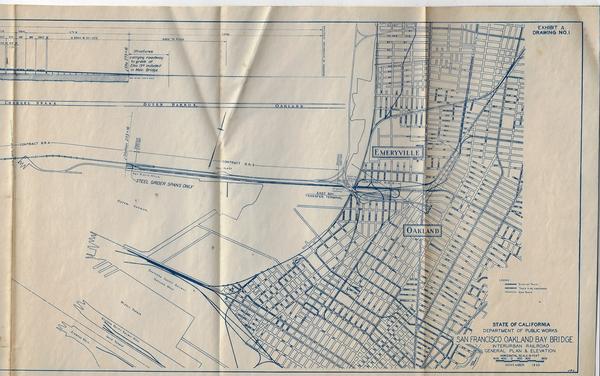
Foldout maps, charts and drawings include the following:
1. STATE OF CALIFORNIA – DEPARTMENT OF PUBLIC WORKS – SAN FRANCISCO OAKLAND BAY BRIDGE INTERURBAN RAILROAD – GENERAL PLAN AND ELEVATION. NOVEMBER 1933
2. STATE OF CALIFORNIA – SAN FRANCISCO-OAKLAND BAY BRIDGE PROFILE AND DIAGRAMATIC ALIGNMENT INTERURBAN RAILROAD BETWEEN SAN FRANCISCO AND OAKLAND. NOVEMBER 1933
3. STATE OF CALIFORNIA...SAN FRANCISCO-OAKLAND BAY BRIDGE INTERURBAN RAILROAD SAN FRANCISCO LOOP TERMINAL – NOVEMBER 1933.
4. STATE OF CALIFORNIA….SAN FRANCISCO OAKLAND BAY BRIDGE INTERURBAN RAILROAD EAST BAY TRACKS AND TRANSFER TERMINAL – NOVEMBER 1933
5. STATE OF CALIFORNIA – SAN FRANCISCO-OAKLAND BAY BRIDGE INTERURBAN RAILWAY PLAN AND SECTION OF EAST BAY TRANSFER TERMINAL – NOVEMBER 1933
6. STATE OF CALIFORNIA – SAN FRANCISCO – OAKLAND BAY BRIDGE GENERAL TYPE OF EQUIPMENT PROPOSED FOR INTERURBAN RAILROAD – NOVEMBER 1033
7. STATE OF CALIFORNIA – SAN FRANCISCO- OAKLAND BAY BRIDGE SUPERSTRUCTURE – EAST BAY CROSSING 288 FT. SPANS – CLEARANCES ON 1500 FT. CURVE. NOVEMBER 1933
8. STATE OF CALIFORNIA – SAN FRANCISCO – OAKLAND BAY BRIDGE. TYPICAL INTERURBAN RAILWAY CROSS SECTIONS. NOVEMBER 1933
9. STATE OF CALIFORNIA – SAN FRANCISCO OAKLAND BAY BRIDGE INTERURBAN RAILROAD EAST BAY TRANSFER TERMINAL PROPERTY AND PROPERTY DAMAGES – NOVEMBER 1933
10. STATE OF CALIFORNIA – SAN FRANCISCO – OAKLAND BAY BRIDGE GENERAL TYPE OF EQUIPMENT PROPOSED FOR INTERURBAN RAILROAD. NOVEMBER 1933
11. STATE OF CALIFORNIA – SAN FRANCISCO-OAKLAND BAY BRIDGE. TYPICAL INTERURBAN RAILWAY CROSS SECTIONS. NOVEMBER 1933
12. STATE OF CALIFORNIA – SAN FRANCISCO – OAKLAND BAY BRIDGE INTERURBAN RAILWAY PLAN AND SECTION OF EAST BAY TRANSFER TERMINAL – NOVEMBER 1933
13. Four pages concerning STATE OF CALIFORNIA STANDARD CURVE SUPERELEVATION with a SUPERELEVATION TABLE SHOWING THE RATE OF SUPERELEVATION IN FEET PER FOOT OF ROADBED WIDTH
14. STATE OF CALIFORNIA – SAN FRANCISCO-OAKLAND BAY BRIDGE. SAN FRANCISCO APPROACHES GENERAL PLAN AND ELEVATIONS.
15. STATE OF CALIFORNIA. SAN FRANCISCO – OAKLAND BAY BRIDGE PROFILE AND DIAGRAMATIC ALIGNMENT INTERURBAN RAILROAD BETWEEN SAN FRANCISCO AND OAKLAND. NOVEMBER 1933
16. PLUS A LOT OF RELATED MATERIALS
Construction began on July 9, 1933[ after a groundbreaking ceremony attended by former president Herbert Hoover, dignitaries, and local beauty queens . The construction project had casualties: twenty-four men would die while constructing the bridge. The total cost was US $77 million (equivalent to $1.74 billion in 2024).
The bridge opened on November 12, 1936, at 12:30 p.m. In attendance was former President Herbert Hoover, Senator William G. McAdoo, and the Governor of California, Frank Merriam. Governor Merriam opened the bridge by cutting gold chains across it with an acetylene cutting torch. At its opening the toll was 65 cents (equivalent to $14.73 in 2024), collected in each direction by men in booths fronting each lane of traffic. Within months, the toll was lowered to 50 cents in order to compete with the ferry system, and finally to 25 cents since this was shown sufficient to pay off the original revenue bonds on schedule (equivalent to $10.94 and $5.47 in 2024 respectively).
All documents, maps, etc. are in vg condition.