ALASKA MINING RECORD
TWO ISSUES OF ….. THE SCARCE ALASKA MINING RECORD
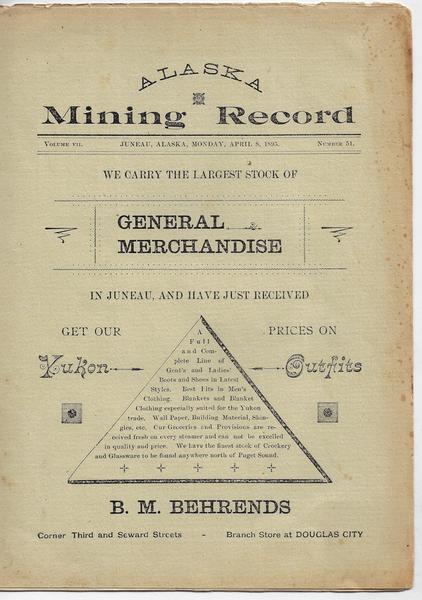
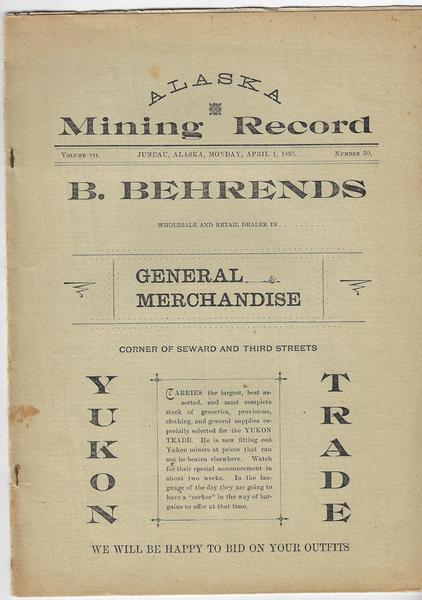
(ALASKA -- YUKON-KLONDIKE GOLD RUSH). ALASKA MINING RECORD. Swinehart, G. B. (ed.). Two issues being Volume VII – JUNEAU, ALASKA, MONDAY, APRIL 1, 1895 – NUMBER 50 and VOLUME VII - JUNEAU, ALASKA, MONDAY, APRIL 8, 1895 – NUMBER 51. 14 pgs including advertisements. Contents include an interesting Letter From An Old Juneau Boy in the Yukon; Letter Setting Forth The Real Condition of Affairs There; Earliest Actual Mining That Was Done On The Yukon; F.L. Weaver Relates Incidents of Pioneer Yukon Life; Over The Pass. The Shortest, Quickest and Cheapest Way To The Yukon; Liquor In Alaska; On The Yukon Trail: The Miners Are Scattered From The Beach To The Lakes; Among The Miners; Resume Of What Is Being Done In Various Camps; Yukon Justice: A Young Girl Secures Her Rights Through A Miners’ Court….
THE ALASKA MINING RECORD is an extremely scarce Alaska mining publication reporting on the latest discoveries in the Yukon prior to the Klondike Gold Rush Stampede, which would later draw over 100,000 miners flooding into Alaska and the Northwest Territories from 1898-1899. Frank Bima in the April 1, 1895 reports on the gold strikes along Glacier Creek about 60 miles west of Dawson City, and the scarcity of musicians, and erection of a theater in Circle City for the miners. Another letter in the same issue strongly cautions against a wild gold rush, that the Yukon would be overwhelmed, and the mining conditions brutal. In the article on the “Shortest, Quickest and Cheapest Way to the Yukon” the editors advise that “Inexperienced persons unless prepared for long extended delays should stay away; gold-finding is a science which can be acquired only in its native fields, and the art must be mastered elsewhere for in Alaska there is no time for pondering.” The ads on the cover, and interior advise on the complete lines of “Gent’s and Ladies’” clothing, blankets, and equipment for the Yukon; mining outfits and general merchandise to be purchased from the Juneau Trading Co., Miners’ supplies, hardware, tinware, and more to be purchased from the Alaska-Treadwell Gold Mining Co., etc.
The second issue for April 8, 1895 includes a report on the number of people scattered along the route from Juneau to the Yukon, which at the time encompassed 425 men, women & children largely awaiting the break-up of the Yukon River ice. A few of the articles report on the mining progress in various gold fields, many overseen by the Juneau Mining Co. Of particular interest is the article on a young Swedish-American girl obtaining a judgment for wage compensation from the nefarious C.H. Hamilton, trader at Fort Cudahy on the Yukon River. The young Swedish-American girl had been induced to take a job as a household domestic, with guarantee of $ 30 per month, room and board, and transportation from the time she stepped onboard the boat at San Francisco, CA with little awareness she would have to travel to Fort Cudahy on the Yukon River. Upon arrival, Hamilton lays down very specific rules for her, including a 10:00 PM curfew, which she unwittingly breaks after visiting the only other white woman in the settlement, Mrs. Aylward. After locking her out, and firing her without
payment in the middle of Winter, the Miners Court returns a verdict she should be paid the full amount of her contract, along with $ 150 to return her to San Francisco. The Miners Court members subsequently went in force to the store, and Hamilton “settled in full of all demands, but , however, with the remark that they could have the whole d__d store, if they wanted it. But the jury in this case didn’t want the store, but, however, they did want to see justice done to that lonely girl who had been turned out homeless in a mining camp upon a desolate frontier.”
G.B. Swinehart would leave Juneau, Alaska in 1898 with the intention of starting a newspaper in Dawson City, Yukon, although his journey would stall at Caribou Crossing and he would produce there a single issue, the first document known to have been printed in Canada’s North, before moving on to publish The Yukon Sun. The firm was also known for their souvenir editions, such as the 1897 land promotion for Juneau as the “Key City” of the far Northwest, in conjunction with photos from Winter & Pond.
Original issues are very rare, and nearly all of the holdings in the Alaska University
Libraries, and other institutions listed either in Worldcat, or other references, refer to the Microfilm copies originating in the Library of Congress, rather than original paper issues, and the bulk date
from 1898-1899 when the paper ceased publication. Worldcat does locate one of the 1895 weekly issues in their holdings (Febuary, 1895 Souvenir Edition).
Reference: Kurutz, Klondike & Alaska Gold Rushes, A Descriptive Bibliography, 20 (1897 Souvenir Issue)
Meaghan Scanlon, Canada’s Earliest Printers, Library & Archives Canada Blog (August 28, 2018); Guide to Alaska Newspapers on Microfilm.
Some minor toning to fore-edges, light spotting, minor edge-wear & pulling, still a VG pair of original issues.