

REMINISCENCES OF MY EARLY EXPERIENCE IN IOWA
Hillhouse, William. Written on ffep To Frank Chamberlin by Friend Wm. Hillhouse.
Manuscript reminiscences by highly recognized and influential figure William Hillhouse, and early pioneer in Iowa. He was highly regarded in public affairs, with influential political figures backing his consideration for major regional roles such as a supervising inspector. In it Hillhouse records his memories of his pioneer days in eastern Iowa, beginning around 1840. At one point he “Engaged my services to the Indian trading Establishment of J.P. Eddy as clerk in this Store in the village of Mish-E. Qua-Mah-guet, now called Eddyville”. Some of the individual who he was traveling with were John C. Breackenridge, a young Lawyer; Dickerson, a Merchant; H.T. Huggins Atty at Law and Joseph Baltzer a gentleman of leisure. John C. Breackenridge lived to be Vice President of the United States. This detailed diary travel narrative contains numerous descriptions of his interactions and trading with the Sac and Fox and other Plains tribes, including an early account of a buffalo hunt. He died on December 31, 1894.
Selections from Hillhoue’s reminiscences:
Page 1. “I left Chillicothe Ohio. October 3d, 1840 on Horse back for Burlington, Iowa. I was Eleven days traveling through to the Mississippi river & crossing over to Burlington in the Evening of October 14th Ending my Journey through the States and landing in the Territory of Iowa.”
Page 2. “…..brings fresh to my Memory of the Early Territorial days Spent in Burlington when I could See the wild Indians of Iowa, hanging around the Governors House. Wanting the opportunity to hold a council or Pow-Wow with the big Chief as they termed the Governor. They would on Such occasions come in the gaudiest of Indian Costumes with there plumes, feathers and paint, gaudy blankets beads and wampum and would parade the Streets through the day. Shooting at the five cent pieces with the bow and arrow to the amusement of the bystanders and frequently at night would have war Songs and dances which always drew crowds of the new comers around them out of Mere Curiosity all of which gave it the appearance of an uncivilized Town.”
Pages 5-6. “My first Experience with a prairie wolf was the first fall of Snow. After my arrival in Burlington. I was sideing on horse back a Short distance west of town and I discovered a wolf out in the prairrie a Short distance from the road. Right were the Des Moine County fair ground is now located and I put whip and Spur to my horse and gave Chase. I Soon over hauled him, and rode my horse over him Several times Knocking him over and over but he would get up and Start off in another direction the Snow being about two feet deep. I could catch up with him Easily. I then made up my mind to unbuckle my Styrup from the Saddle and side over him once more Knocking him down and Jumping off my horse and hit him over the head with the Styrup until I Killed him. I then mounted my horse with the Wolf thrown acrofs my lap and returned back to town with my wolf prize and halted at W.D. Mclash Livery Stable, which was then Kept on Main Street where the Des Moine County court house is located which has changed the appearance of that locality very much since 1840.”
Pages. 8-9. “In the fall of 1841, My Curiosity was So great to See the tribe of Indians gathered together and receive there annual payment from the agent. I Mounted my horse and went up to the Agency as a Spectator which was the Custom of hundreds of people from all over the territory..
It took about a week to get through the payment and it was quite interesting and amusing to See So many Indians Collected together, and the ways and manner they would amuse them Selves by Horse racing, War dances, games of various Kinds and Squaw dances. They would dress themSelves in the most hideous Styles imaginable, with paints of all Collors and feathers of all Kinds, beads & Wampaum with little tingling bells Strung all over them which made them feel very haught and pompus.”
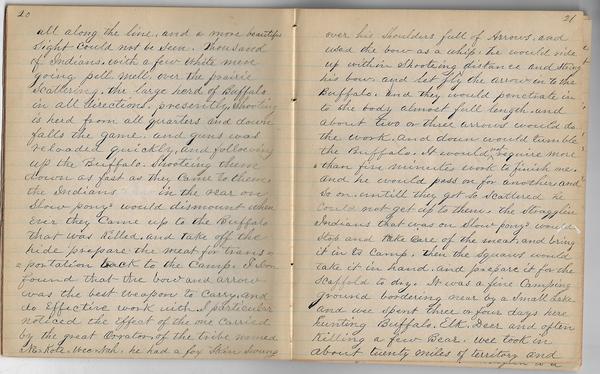
Pages 18-22. “….The party of white men were always admitted in the Council. It was very amusing and interesting, to the Burlington party to be an Eye witness to their grand Pow-Wow, but we Soon learned, that it was Buffalo, they had discovered, and not the Sioux Indians, it was a very large herd feeding in the valley about fifteen miles off from where we was Camping. After the Council was over a new Set of Scouts was Sent back to Keep watch of the Buffalo. The next morning being the 4th of July the white men thought to themselves they would celebrate by firing at Buffalo. The sight was a very restless one in and around the Camps. All Seemed to be Excitement, the guns was put in order ready for action and Morning Came Every one was ready and by ten o’clock we was Close to the Scene of action. Where the Scouts Stationed watching the Buffalo that was feeding over in the valley. The rolling ridge in the prarie prevented the Buffalo from Seeing us. When we came in a mile of the ridge a halt was Called and ordered to pitch Camp for a day or two. The Squaws went to work fixing up the wig wams, and unloading the Surplus ponys of their packs. The warriors & Chief went off in the lead to the foot of the ridge and halted until we all came up. Some Eight or Nine hundred Indians after holding a Short Council So as to determine how the attack Should be made. While they was planing the way the balance would go and Back up to the top of the ridge and peep over in the large Valley, at the Buffalo which was not more than a half of a mile off. The order was to file in a line at the base of the ridge and when the Signal was given to make the Charge all along the line, and a more beautiful Sight could not be Seen. Thousand of Indians with a few white men going pell mell over the prairie Scattering the lage herd of Buffalo in all directions presently Shooting is herd from all quarters and down falls the game and guns was reloaded quickly and following up the Buffalo Shooting them down as fast as they Came to them. The Indians in the rear on Slow ponys would dismount when Ever they Came up to the Buffalo that was Killed and take off the hide prepare the meat fro transportation back to the Camp. I soon found that the bow and arrow was the best weapon to carry and do Effective work with. I particular noticed the Effort of the one carried by the great Orrator of the tribe named Ne-Kote-Ubec-Nah. He had a fox skin Swung over his Shoulders full of Arrows and used the bow as a whip. He would ride up within Shooting distance and String his bow and let fly the arrow in the Buffalo and they would penetrate in the body almost full length and about two or three arrows would do the work and down would tumble the Buffalo. It would not require more than five minutes work to finish one. And he would pass on for another and So on until they got So Scattered he Could not get up to them. The Stragglin Indians that was on Slow ponys would Stop and take Care of the meat and bring it in to Camp. Then the Squaws would take it in hand and prepare it for the Scaffold to dry. It was a fine Camping ground bordering near by a Small Lake and wee spent three or four days here hunting Buffalo, Elk, Deer and often Killing a few Bear. Wee took in about twenty miles of territory and after hunting the ground over thoroughly we Struck Camp and left for new hunting grounds.”
Pages 36-38. “After returning to there Villages in the Spring and before they would Settle down, they generally would have a big Spree or drunk and they would prepare for Such an occasion. The Squaws would gather up the Children of the Village and Scatter off to the garden & field patches, where they intended to Cultivate there Corn and beens during the Summer. They would build brush and pole fences around the patches of ground and get Everything in order for Spring work while the Bucks was having a Spree in the Village. The Indians would have to Send Some forty miles for the whiskey or Scoo-ti-ao-po and by the time they would return back to the Village with it the Squaws and papposes was all Scattered off to the farm patches. Except a half a dozen or So Who would Stay and disarm the Indians of all their weapons as fast as they would become drunk. So they Could not harm Each other. Once in a while they would get to fighting Each other while drunk and the Squaws what was Ever watch full would Soon take them in hand and would tie them hand and foot until they would begin to get Sober. And then turn them loose So they Could finish up their Spree. It took quite a number of Kegs of whisky for this annual Spree and quite a number of Indian ponys to buy it from the Whisky traders who lived down on the line of Settlements between the Indians and Whites. The Spree generally lasted three or four days Sometimes a week and no one was allowed to go in to the village while they was on the Spree. The Sober Squaws guarded the Village and Kept the drunken Indians in and Everything Else out.”
80 pgs plus 2 written in a 6 x 7 ½ inch marbled covered notebook. Last 2 unnumbered pages titled INDIAN MODE OF COUNTING, which gives the Indian language equivalent for English numbers, words and phrases such as as horse, saddle, pretty girl, bad, Negro, egg, chicken, how do you do my friend, stylish young girl, etc. Very legible and very interesting. With the exception of the detached covers, it is in vg cond.
Source: The Annals of Iowa Archive – 1895. Captain William Hillhouse
An unusually dramatic and exciting reminisces of life in Iowa in the 1840’s.
Cond:. several pages have been repaired along with some signatures and it has been resewn. A new leather spine to match the original and placed into an archival box.