

Woman's Anti-suffrage
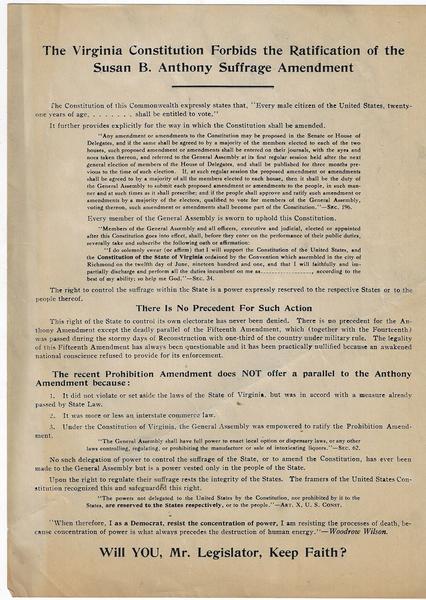
THE VIRGINIA CONSTITUTION FORBIDS THE RATIFICATION OF THE SUSAN B. ANTHONY SUFFRAGE AMENDMENT. It was printed to express anti-suffrage sentiments and reflects the intense legal and political arguments deployed by Virginia's conservative leadership in the opposition to women's suffrage. Anti-suffragists argued that because the 1902 Virginia Constitution explicitly restricted the electorate to males, the state legislature did not have the constitutional authority to override its own state charter by ratifying a federal amendment. The insisted that only a statewide voter referendum (of men) could alter Virginia's voting requirements. This anti-suffrage message did succeeded locally and the Virginian General Assembly rejected the amendment in February 1920. However, when Tennessee became the 36th state to ratify the 19th Amendment in August 1920, federal supremacy rendered the broadside's legal arguments void, granting the right to vote to women. From the broadside: "THERE IS NO PRECEDENT FOR SUCH ACTION. This right of the State to control its own electorate has never been denied. There is no precedent for the Anthony Amendment except the deadly parallel of the Fifteenth Amendment, which (together with the Fourteenth) was passed during the stormy days of Reconstruction with one-third of the country under military rule. The legality of this Fifteenth Amendment has always been questionable and it has been practically nullified because an awakened national conscience refused to provide for its enforcement." Sources: National Museum of American History; Library of Virginia. C. 1919-1920. 1 sheet broadside. vg cond. An important women's anti-suffrage broadside.